






What is MCP, and why does it matter for enterprise AI? Those two questions are rapidly becoming the most consequential infrastructure decisions technology leaders face in 2026. Every new agent your team ships needs access to your CRM, your ERP, your document repositories, your internal databases. Without a standard way to connect these systems, every new integration becomes a custom engineering project: bespoke schemas, one-off auth flows, fragile adapters that need maintenance every time a tool surface changes. Many organizations are already reporting integration complexity as the primary bottleneck as agent deployments scale, and the Model Context Protocol is the open standard gaining the most production traction in response.
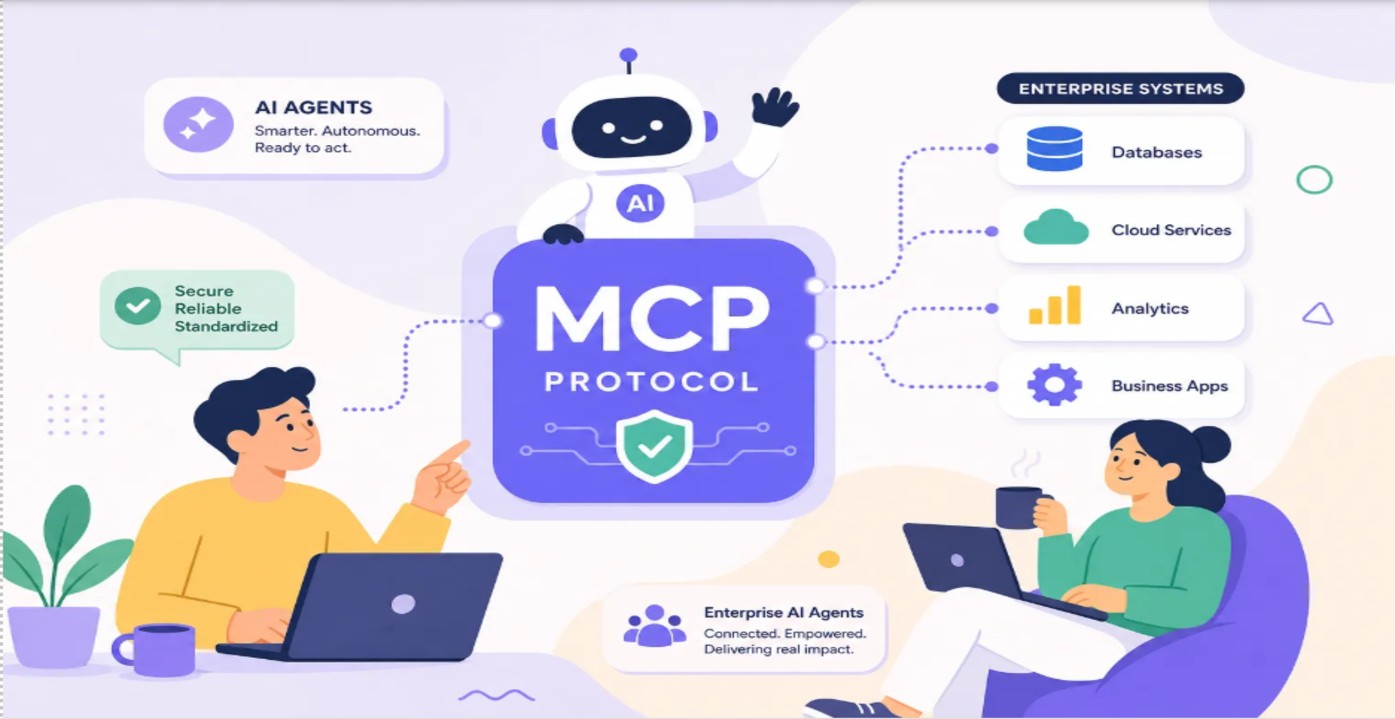
MCP is an open protocol that defines how LLM applications connect to external tools, data sources, and services through a consistent client-server interface. Think of it as the USB-C port for AI agents: one interface, many compatible devices. As of 2026, MCP-compliant architectures are running in production across regulated industries, Block and Bloomberg are among the most documented examples, and enterprise AI firms like Pixonix AI are building to this standard for clients navigating compliance-heavy environments. By the time you finish this article, you’ll know what MCP actually is under the hood, why it’s outpacing the alternatives, what security controls need to be in place, and how to evaluate whether your architecture is ready for it.
What Is MCP and Why Does It Matter for Enterprise AI
The three-role architecture that makes MCP work
MCP is built around three clearly separated roles. The Host is the LLM application that initiates connections: your AI assistant, your agent orchestration layer, your enterprise chatbot. The Client lives inside the host and manages the connection to external services. The Server is the service that exposes capabilities and data to the model. This separation is what makes MCP portable: the host and client can stay consistent while the servers behind them change, scale, or multiply.
All MCP messages run on JSON-RPC 2.0, which means the protocol stack is familiar to any engineering team already working with modern APIs. There’s no new wire format to learn. The current spec revision, dated 2026-07-28, moved the protocol core to stateless, per-request capability negotiation. Each request now carries its own version and client capability data, which means MCP servers can sit behind standard round-robin load balancers without sticky sessions or shared session state, a meaningful architecture simplification for enterprise deployments at scale.
Tools, resources, and prompts: the three server primitives
An MCP server exposes exactly three types of things, and together they cover the vast majority of enterprise integration scenarios. Tools are callable actions: query a database, create a support ticket, send an email, trigger a workflow. Resources are readable context objects: files, records, documents, structured data the model can read without performing an action. Prompts are reusable task templates that standardize how models should approach common workflows. You define the server once, expose your tools and resources through the standard interface, and any MCP-compatible host can consume them without additional wiring, substantially reducing the need for bespoke schema design across agents with each new deployment.
How MCP Connects AI Agents to Your Enterprise Stack
The discovery, invocation, and result loop
The runtime workflow follows a clean loop that enables genuinely autonomous multi-step agent behavior. First, the host application connects to the MCP server and establishes the protocol version. The client then queries what tools and resources the server exposes. Those tool descriptions, names, descriptions, and parameter schemas, get injected into the LLM’s context. The model reads the available tools and decides which one to call based on the task at hand.
Once the model produces a structured tool request, the MCP client forwards it to the server. The server executes the action against the real underlying system, whether that’s a database, a third-party API, or a file system, and returns structured output. That output gets injected back into the model’s conversation, and the model reasons forward from there. The loop repeats until the task is complete. This is what separates MCP-enabled agents from single-shot completions: they can chain multiple tool calls across multiple systems without human orchestration between steps.
A concrete enterprise workflow example
Consider an agent tasked with generating a weekly sales summary. It connects to the MCP server and discovers a database_query tool. It calls that tool to pull live pipeline data from the CRM. It then discovers a report_formatter tool, passes the raw data through it to generate a structured summary, and finally calls email_send to deliver the finished report to the relevant stakeholders. The entire sequence runs without human intervention between steps.
Critically, the LLM typically does not hold direct database credentials or API keys at any point. The MCP server mediates every call, which means your security perimeter stays intact even as the agent operates across multiple systems. That separation of concerns is fundamental to why MCP can be governed properly in enterprise environments, and it’s a key part of why MCP and enterprise AI governance are increasingly discussed together.
Why Enterprises Are Choosing MCP Over Alternatives
MCP vs. function-calling and custom connectors
Function-calling is the lightest-weight option for a single application. It lets a model request a function by schema, and for narrow, contained use cases it works well. But it pushes the full burden of schema design, auth handling, retries, and error management onto the application team. Schemas built for one model or framework don’t port cleanly to another. As the number of agents and hosts grows, the governance overhead compounds and you end up maintaining integration logic in every application separately.
Custom connectors are scoped to a specific platform ecosystem. They work fine when you’re staying inside that ecosystem, but they require manual updates when tool surfaces change, and they don’t travel across vendors or runtimes without a rebuild. MCP addresses both problems simultaneously: one server definition exposes multiple tools, updates dynamically, and works across any MCP-compatible client or host. You write the integration once, and it serves every agent that needs it.
The portability argument for regulated industries
For organizations in banking, healthcare, or government, the portability benefit compounds over time in a way that directly affects compliance costs. These organizations typically run multiple AI systems across different vendors, different model providers, and different internal runtimes. Without a standard, every new model deployment triggers another round of custom connector builds, each carrying its own auth implementation, its own logging logic, and its own governance controls.
With MCP, the same server can serve multiple agents across multiple hosts. Access controls and audit logging only need to be implemented once at the server layer, not duplicated across every integration. For technology leaders managing compliance obligations, that architectural consolidation isn’t a convenience feature; it’s a material reduction in risk surface and operational overhead.
Security and Governance When Models Connect to Internal Systems
Authentication, least privilege, and input validation
Every MCP server your organization runs should be treated as a privileged integration endpoint, not a convenience layer. The current best practice for remote server authentication is OAuth 2.1 with PKCE using the S256 method, with access tokens scoped narrowly to the specific server and tool set being accessed. Per the MCP specification, tokens must be issued specifically for the MCP server and must not be forwarded to upstream APIs. Any authorization request that arrives without PKCE should be rejected.
RBAC at the tool level is non-negotiable in enterprise deployments. The agent should only be able to call the tools its role permits. Strict JSON Schema validation on every tool call prevents injection attacks, and destructive or sensitive operations, anything that writes, deletes, or transmits data, should require explicit human approval before execution. Letting agents make autonomous decisions on high-risk actions is a common source of production incidents.
Audit logging and SIEM integration for compliance
Every tool invocation through MCP needs to produce a structured log entry. That entry should capture user identity, agent identity, tool name, arguments passed, result received, and whether any policy override occurred during the call. This is the audit trail that makes an MCP-connected agent compliant rather than a liability, not optional infrastructure to be retrofitted later.
Those logs need to flow into your organization’s SIEM for anomaly detection. Unusual tool usage patterns, privilege escalation attempts, token replay events, and abnormal error rates are all detectable at the SIEM layer if the logging is structured correctly. For regulated industries specifically, building this logging framework in from day one is the difference between an agent that passes an audit and one that creates compliance exposure. Organizations that treat it as an afterthought invariably rebuild it under pressure.
What Enterprise MCP Adoption Actually Looks Like in 2026
Early evidence from production deployments
The public evidence base is still growing, but the leading examples are credible. Block reported productivity gains of up to 75% less time on daily engineering tasks using MCP-connected agents running on their internal “Goose” architecture. Bloomberg implemented MCP as a remote-first, multi-tenant internal platform with identity-aware middleware covering authentication, rate limiting, and observability. Their teams reported reducing demo-to-production timelines from weeks to minutes by building a governed productionization loop around MCP’s tool-exposure model. Both figures are vendor-reported and should be treated as directional rather than independently verified benchmarks.
Across comparable enterprise implementation contexts, replacing custom integration code with a standardized MCP server layer has been reported to reduce integration timelines by roughly 48 to 60 percent, again, based on vendor-reported estimates rather than controlled studies, so the conservative end of that range is the more defensible figure for planning purposes. Beyond speed, the architectural benefit of centralizing governance at the server layer tends to produce lower error rates in automated workflows and cleaner compliance trails, since logging and access controls no longer need to be re-implemented across every individual integration.
How to evaluate MCP readiness in your architecture and partner selection
For organizations building or procuring agentic AI systems in 2026, MCP compliance is becoming a meaningful evaluation criterion rather than a forward-looking aspiration. Internal readiness starts with a straightforward architectural audit: Do your enterprise systems expose APIs that can be wrapped as MCP servers? Do you have centralized identity management that can back OAuth 2.1 flows? Do you have log infrastructure capable of capturing structured, per-invocation audit trails? A “no” on any of those is the remediation starting point before MCP adoption makes sense at scale.
When evaluating an AI development partner, the distinction between demonstrated MCP production experience and theoretical familiarity matters significantly. Prototype implementations built in isolation don’t surface the governance and observability requirements that emerge in enterprise environments. Look for partners who treat MCP compliance as a core architecture requirement built in from the initial system design, not an optional add-on bolted on at the end. At Pixonix AI, that approach reflects the compliance and integration portability requirements we see consistently across clients in regulated industries, where anything less creates genuine risk exposure.
The Structural Shift MCP Represents
The central question in enterprise AI integration right now is whether your organization will build its agent infrastructure on a standard or continue accumulating custom connectors that need to be rebuilt every time a model or platform changes. MCP provides the standardization layer that makes enterprise AI agents genuinely scalable, auditable, and portable across systems and vendors. It’s a leading approach gaining real production traction, and understanding what MCP is and why it matters for enterprise AI is increasingly the kind of architectural judgment that separates organizations building durable AI infrastructure from those perpetually catching up.
For technology leaders evaluating or building agentic AI in 2026, the practical question isn’t whether to adopt MCP. It’s how quickly your current infrastructure can support MCP-compliant architectures and whether your development partners are building to that standard. Organizations that get that answer right early spend less time rebuilding integrations and more time extracting value from the agents they’ve deployed. The foundation decision determines whether your AI infrastructure compounds in capability or accumulates in technical debt.
If your organization is evaluating MCP adoption or building agentic AI systems that need to meet enterprise compliance and integration standards, reach out to the Pixonix AI team directly. We work with technology leaders to design and deliver MCP-compliant architectures built to production standards from day one.