







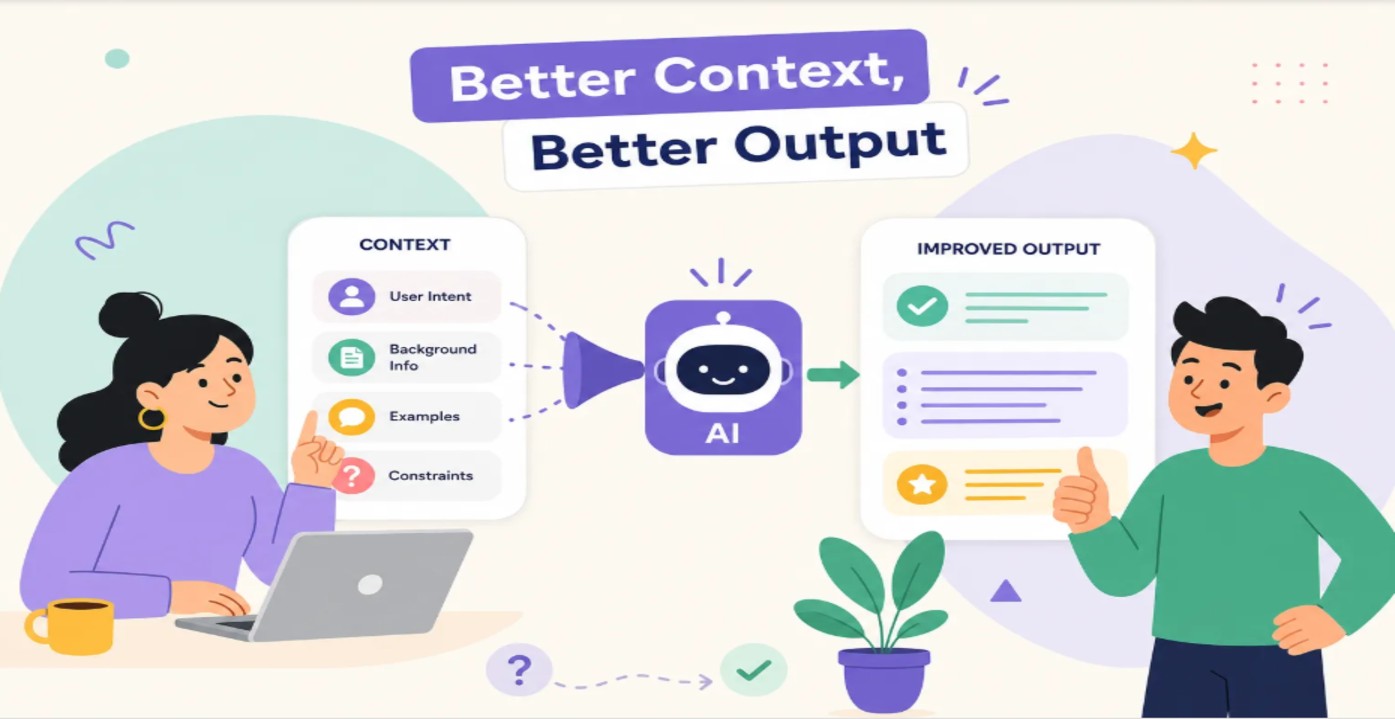
What is context engineering, and why does it matter more than the prompts you’re writing? Context engineering is the discipline of deliberately selecting, structuring, and optimizing the information fed into an LLM’s context window at inference time, so the model produces correct, relevant, and cost-efficient outputs. Many engineering teams assume a well-crafted prompt is the primary lever for improving LLM output quality. That assumption explains why so many production AI systems underperform. A thoughtful prompt is necessary, but it’s not sufficient. The gap between a well-worded instruction and a consistently accurate, production-grade response is precisely where context engineering lives.
Context engineering is not a writing exercise. It’s a system-level engineering practice that determines what the model knows, in what format, and in what order, before any generation begins. Enterprise AI teams that build production LLM systems for regulated industries treat context engineering as a foundational architectural layer, not an afterthought. At Pixonix AI, it’s one of the core disciplines we emphasize in AI solutions built for clients in banking, healthcare, and government.
This article covers the full picture: how context engineering differs from prompt engineering, what actually populates a context window in production, the four primary patterns for context selection, the production techniques that make those patterns reliable at scale, and the evaluation metrics that tell you whether your design is working.
What Is Context Engineering vs. Prompt Engineering
The clearest way to separate these two disciplines is this: prompt engineering is about how you ask the model; context engineering is about what the model knows when it answers. Prompt engineering covers the wording, structure, few-shot examples, and formatting of the instruction itself. Context engineering is the broader discipline that decides which retrieved documents, prior conversation history, memory objects, tool outputs, and metadata enter the model’s context window before any instruction is processed.
Where prompt engineering ends
Consider a customer support bot with a perfectly worded instruction: “Offer a refund if appropriate.” That instruction is fine. But if the model doesn’t receive the customer’s purchase history, warranty status, and current policy documents alongside it, the instruction is useless. The prompt engineering is sound; the context engineering is broken. Debugging these two failure modes requires entirely different thinking, and conflating them is a frequent cause of stalled AI projects.
The system-level shift context engineering demands
Prompt engineering fixes one request at a time. Context engineering designs the entire pipeline that determines what information reaches the model’s context window across every request, every time. Think of the difference between editing a memo and designing the information architecture of an organization. A practical rule: if you’re improving a single query, you’re mostly doing prompt engineering. If you’re designing what flows into the context window at runtime across a production system, that’s context engineering. Prompt engineering is, in fact, a subset of context engineering, not the other way around.
What Is Context Engineering in Practice: What Lives Inside an LLM’s Context Window
Some engineers initially think of the context window as “the prompt plus the response.” In production systems, that mental model is far too thin. The context window is a layered information environment that can hold system instructions, retrieved document chunks, conversation history, user metadata, tool call results, memory retrievals, and structured data payloads, all simultaneously. Each layer competes for tokens, and the model treats every element as evidence when generating its response.
The information layers a model receives at inference time
Context engineers actively manage six distinct information types: system-level instructions that define behavior, grounding documents pulled from retrieval, conversational memory from prior turns, tool outputs injected mid-sequence, user-specific session state, and output format constraints. Each has a distinct role in shaping generation. When engineers treat them as interchangeable or allow them to bleed into each other, the result is context pollution, a failure mode in which conflicting signals from different layers cause the model to produce inconsistent or degraded output, undermining its ability to reason clearly about any individual layer.
Why ordering and structure shape what the model prioritizes
LLMs don’t treat all positions in the context window equally. Research on long-context models has documented what’s widely called the “lost in the middle” problem: information placed at the beginning and end of a long context receives significantly more attention than content buried in the center. Context engineers account for this by deliberately placing the most critical evidence, key policy documents, the most relevant retrieved chunks, explicit constraints, where the model’s attention is strongest. Sequencing is not a cosmetic choice; it directly affects output quality.
The four core patterns for context selection and curation
No single approach works for every LLM task. Context engineering defines four primary patterns, and the right choice depends on the nature, size, and volatility of the information the model needs at inference time. Understanding these patterns is central to answering what context engineering actually does in a production system.
RAG and in-prompt context for grounding outputs in evidence
Retrieval-augmented generation is the default pattern when the answer depends on a large, dynamic, or proprietary knowledge base. Documents are chunked, embedded into a vector database, and retrieved at query time to ground the model’s response in source text rather than its parametric memory. In-prompt context is the right choice when the needed information is small, stable, and available ahead of time: system policies, format schemas, few-shot examples, or a short document excerpt. A common production upgrade to basic RAG is retrieve-then-rerank: retrieve a broad candidate set first, then filter for relevance quality before passing chunks to the model. This two-stage approach meaningfully improves what actually enters the context window.
To make this concrete, consider a simplified RAG payload. The context window might contain: a system instruction defining the response format, three retrieved document chunks ranked by a cross-encoder reranker, a user query, and a memory object with session preferences. Each element occupies token budget. Context management for LLMs at this level means deciding not just what to retrieve, but how much of each layer to include before hitting the model’s token ceiling.
Memory and streaming context for continuity and latency
Memory patterns store prior interaction state so conversational agents can maintain continuity across turns, remember user preferences, and personalize responses without re-sending full conversation history each time. This is a stateful pattern, not a retrieval pattern, and the two should not be conflated. LLM memory and agent context become especially important in multi-turn enterprise workflows where a single conversation may span dozens of exchanges across a session. Streaming context is primarily a latency pattern: it allows the model to begin generating while retrieval and reranking are still completing, reducing time-to-first-token in interactive systems. The practical selection guide: use in-prompt context for small, stable information; use RAG for large or frequently changing knowledge; use memory for cross-turn continuity; use streaming when latency is the binding constraint.
Context compression and retrieval quality: the production engineering layer
Knowing the four patterns is the starting point. Making them work reliably at production scale requires a second layer of techniques that address token cost, retrieval noise, and context window efficiency. This is where many teams stall: their RAG pipeline works in a demo but drifts in production because they haven’t engineered the compression and quality-control layer.
How context compression reduces cost without sacrificing accuracy
Context compression refers to systematically reducing what enters the context window while preserving the information density that matters for the answer. Techniques include chunk summarization before retrieval, recursive summarization for long documents, and middleware that prunes irrelevant retrieved segments before they reach the model. At Pixonix AI, we apply context compression as a cost control mechanism alongside accuracy management in production LLM systems built for finance and healthcare clients. The goal is to stay within token budgets without degrading output quality, and those two objectives require deliberate engineering, not trial-and-error prompting.
A useful way to think about the token-cost tradeoff: passing all retrieved chunks verbatim may improve recall but increases cost per request proportionally. Summarizing or pruning low-relevance chunks before injection can reduce token consumption significantly while maintaining answer quality for most queries. The right operating point depends on your cost and latency constraints, and finding it is a measurable engineering problem, not a judgment call.
Retrieval ranking and relevance filtering as a quality gate
Vector database retrieval using embeddings surfaces semantically similar chunks, but similarity alone doesn’t guarantee relevance. Reranking models score retrieved candidates against the query after initial retrieval to promote genuinely useful chunks and suppress noise. The combination of semantic retrieval from a vector store plus cross-encoder reranking has become a standard pattern in production RAG pipelines. Context orchestration at this layer means sequencing retrieval, reranking, memory injection, and tool outputs into a coherent, token-efficient context payload before any generation begins. This orchestration work is invisible to end users but directly determines whether the system behaves reliably under real-world query variation.
Evaluating whether your context design is actually working
A context engineering pipeline that isn’t measured isn’t managed. Three evaluation categories matter in practice: retrieval quality, output groundedness, and token-cost efficiency. Teams that skip structured evaluation end up iterating on intuition rather than evidence, which makes systematic improvement nearly impossible.
Retrieval metrics that expose weak context design
Contextual recall measures whether the retrieved chunks contain the information needed to answer the question. Contextual precision measures whether the most relevant chunks are ranked highest, ensuring they occupy the most valuable positions in the context window. Context relevance scores how much of what’s retrieved is actually useful, penalizing noise. For retrieval systems, standard information retrieval metrics including Precision@K, MRR, and NDCG give a ranking-quality signal before any generation happens. These metrics tell you whether your vector store, embeddings, and reranking pipeline are doing their job.
Tracking token cost and latency against output quality
Faithfulness, also called groundedness, measures whether each claim in the model’s output is supported by the retrieved context. It’s the primary metric for hallucination reduction, and in regulated environments like healthcare and financial services, it’s non-negotiable. Beyond quality, track input and output token counts per request, token efficiency measured as quality score per token consumed, and end-to-end latency broken down by retrieval, reranking, and generation stages. The practical goal isn’t maximum quality in isolation; it’s the best quality-per-token operating point your cost and latency constraints allow. Running delta evaluations when you change retrieval strategy, chunking approach, or embedding model is how context engineers make systematic improvements rather than guessing their way to better outputs.
Where the real engineering work in LLM systems actually happens
Context engineering is the difference between an LLM that occasionally produces good output and one that reliably produces accurate output at scale. It’s not about writing better prompts; it’s about designing the information architecture that surrounds every inference. The discipline spans pattern selection across RAG, memory, streaming, and in-prompt context; production techniques including compression, reranking, and context orchestration; and rigorous evaluation against retrieval quality, hallucination rate, and token cost.
For enterprises deploying LLMs in regulated, high-stakes environments, these aren’t optional refinements, they’re the foundation. Pixonix AI builds production AI systems with context engineering baked into the architecture from day one. The accuracy rates and reliability benchmarks our clients in banking, healthcare, and government depend on don’t come from better prompts; they come from better context design.
If you still wonder what is context engineering and how it applies to your system, start by auditing your context pipeline, not your prompts. A useful checklist: Are retrieved chunks ranked by relevance before entering the context window? Are you measuring contextual recall and faithfulness in production? Are you tracking token cost per quality point? Are your information layers, instructions, memory, retrieved grounding, tool outputs, clearly separated and sequenced deliberately? That’s where the leverage is. If you want a team that applies these context engineering practices at enterprise scale, contact our team at Pixonix AI to discuss your architecture.