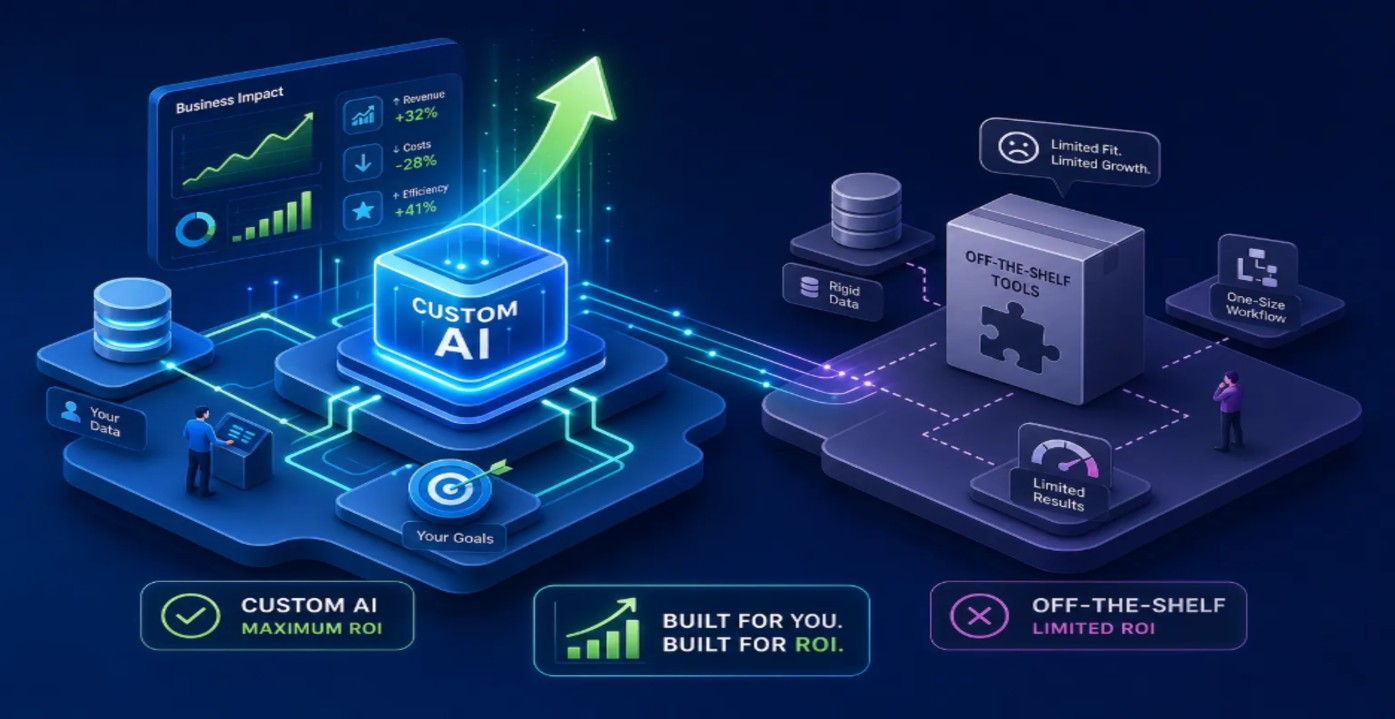
Many enterprise AI pilots fail not because the technology is wrong, but because it was never built for the actual business problem. Custom AI development solves that gap by building models and integrations tailored to your proprietary data, your workflows, and the compliance standards your industry actually requires. A generic AI tool promises speed and simplicity, and in some cases it delivers both. What it rarely delivers is high accuracy on your proprietary data, clean integration with your existing systems, or the audit trail a regulated industry demands before any system can go near production.
Across the UAE and broader GCC, enterprises are moving fast. Corporate AI investment in the UAE surged 521% over 13 months through 2025 (per IDC and UAE government reporting), and 94% of UAE enterprises now believe AI will be a key driver of business expansion. The pressure to deploy is real, and it is pushing many organizations toward the fastest available option. The question worth asking before you commit budget is whether the fastest option is actually the right one for your specific problem.
This guide draws on the kind of work done at Pixonix AI, a Dubai-based firm that has deployed production-ready AI systems across 18+ countries and eight industries. By the end, you should know exactly what building a tailored AI system involves, what it costs, what you need before you start, and how to run a structured vendor evaluation.
What separates custom AI development from off-the-shelf tools
Why generic AI tools hit a ceiling for enterprise workflows
SaaS AI products and pre-trained foundation models are engineered to serve a broad range of customers simultaneously. They are trained on general data, optimized for median use cases, and designed to be deployed with minimal configuration. That broad design philosophy is also their fundamental constraint: they are rarely accurate enough for specialized enterprise workflows, they cannot connect cleanly to proprietary data sources without significant engineering workarounds, and they offer no control over model behavior as your business rules evolve.
For organizations operating in regulated industries, these gaps move from inconvenient to disqualifying. A bank in Dubai cannot put a document extraction model into production if it cannot demonstrate accuracy on its own document types, explain the decision logic to a regulator, or meet UAE data residency requirements. A healthcare network expanding across MENA faces the same challenge with clinical and administrative data. Generic tools are not built to clear those bars, they are built to clear a much lower one. Custom AI solutions, by contrast, are scoped precisely around those requirements from the start.
Your data, your problem, your accuracy
Proof, not just projections: two platforms built this way
The accuracy-gap argument above isn’t hypothetical for Pixonix it’s the operating model behind two production platforms the team has engineered end-to-end:
- AiVaHR – an AI-native HR platform, built to handle the workflows and data structures of the organizations using it rather than forcing HR data into a generic template.
- Safe4Sure – a school-safety and campus-administration platform serving education institutions, built around the compliance and reporting requirements schools actually operate under.
Both were built the way this guide describes: proprietary data, workflow-specific architecture, and compliance requirements defined upfront rather than retrofitted. Neither would have been achievable by configuring a generic SaaS AI tool the workflows are too specific, and the compliance bar (education-sector data handling, HR data privacy) isn’t something an off-the-shelf model is scoped to clear.
A bespoke AI system is trained on your historical data, calibrated to your definitions of success, and stress-tested against your edge cases. That specificity drives meaningful accuracy differences in production. Consider a document extraction model achieving 94.7% accuracy on your actual document set versus a generic alternative achieving 78% on the same task, that is not a marginal improvement. It has a direct and compounding impact on headcount requirements, downstream error rates, and the quality of decisions your teams make from that extracted data. (These figures are illustrative of the accuracy gaps commonly observed in enterprise deployments; actual results vary by document complexity and data quality.)
The gap widens further when integration depth matters. Custom AI solutions can be built to connect natively with your ERP, CRM, government APIs, or proprietary data warehouse rather than relying on fragile middleware. That means fewer failure points, faster data pipelines, and a system that reflects how your organization actually works rather than how a vendor imagined a generic organization might.
The custom AI development lifecycle: requirements to live deployment
Discovery, data preparation, and architecture
The first half of a bespoke AI project covers three phases that determine the quality of everything that follows. Discovery and scoping typically run one to four weeks and produce a clear problem statement, defined success metrics, a feasibility assessment, and a project roadmap. Organizations often underestimate this phase. Cutting it short is the fastest path to expensive post-launch corrections.
Data preparation frequently takes longer than teams expect: anywhere from two to sixteen weeks depending on data quality, volume, and the level of labeling required. Shortcuts here cost more later. Architecture and model selection come next, covering decisions like whether to use API-based approaches, retrieval-augmented generation, fine-tuning, or fully custom ML pipelines, choices with significant implications for long-term cost and maintainability.
Build, integration, testing, and deployment
The build phase covers model training, application logic, API integrations, UI development, and workflow connections. Testing is not a single gate at the end; it runs throughout and includes accuracy evaluation, security controls, red-teaming, and formal acceptance testing. Deployment timelines range from a few days for simple cloud environments to twelve weeks for on-premises or hybrid infrastructure with change management requirements attached.
After launch, the operational reality is ongoing MLOps work: monitoring for model drift, managing retraining pipelines, and maintaining performance reporting. End-to-end, enterprise AI development projects typically run three to twelve months. That is not a long timeline when measured against the multi-year return on a system that actually works, but it is a significant commitment that rewards careful upfront planning.
What custom AI development costs and where the return comes from
Cost benchmarks by project size
Honest cost ranges help enterprises anchor budget planning before the first vendor conversation. Small projects, a focused chatbot or a single workflow automation, typically run between $5,000 and $50,000. Mid-market production builds with multiple integrations and custom ML components commonly fall between $50,000 and $250,000. Enterprise-grade deployments with deep ERP or CRM integration, compliance engineering, and multi-agent architectures regularly exceed $250,000 and can reach $1 million or more.
The main cost drivers are model complexity, the number of integrations required, data preparation effort, security and compliance requirements, deployment environment, and the ongoing MLOps support model. A project with clean, well-labeled internal data and straightforward cloud deployment will always cost less than one requiring data remediation, on-premises infrastructure, and ISO 27001-aligned controls. Understanding those drivers before you scope the project prevents budget surprises mid-build.
Where ROI actually comes from
In financial services, automated document extraction and reconciliation have delivered cost reductions in the range of 70 to 85% in documented deployments, with reporting cycle times reduced by a comparable margin. The mechanism is straightforward: fewer analyst hours spent on manual extraction, reduced errors requiring remediation, and faster close cycles that improve decision timeliness across the organization. In healthcare, administrative automation around claims triage and prior authorization can help reduce operational burden and denial rates in organizations that have replaced manual workflows with purpose-built systems.
In logistics, route optimization and predictive maintenance translate directly into fuel savings and higher asset utilization, with measurable reductions in late deliveries. In each case, the ROI compounds across thousands of transactions per month. A 70% reduction in document processing cost does not require a favorable set of assumptions to close the business case. It requires a system that actually performs at that level on your data, which is the core argument for custom AI development rather than defaulting to a generic alternative that may perform significantly below that threshold on your specific document types.
Data and infrastructure readiness before you build
What data you need and how much
The most common question enterprises ask before starting is whether they have enough data. The honest answer is that it depends on the task. For early classification prototypes, 100 to 500 labeled examples per category can get a model training. Production-grade supervised systems often need 1,000 or more labeled examples per class. Time-series models typically require two to three years of history for meaningful seasonal pattern detection.
Label quality matters more than raw volume. A smaller, well-labeled dataset consistently outperforms a larger, inconsistently labeled one. Before any vendor conversation, document your data types, total volume, time span, and whether personal data is involved. That inventory forms the basis for accurate project scoping and prevents wasted discovery time during the engagement.
Infrastructure choice and the skills required
The cloud versus on-premises decision is not purely a technical one for UAE and GCC enterprises. Local data sovereignty requirements mean that some datasets cannot be processed outside a specific jurisdiction. Cloud infrastructure offers faster experimentation and elastic GPU access for development; on-premises or hybrid setups become necessary when data residency rules apply. Clarifying that constraint early shapes every other infrastructure decision in the project.
On the team side, the roles required, whether in-house or through a vendor, include a domain expert to define success metrics, a data engineer to prepare and version data, labelers or an annotation vendor for quality label creation, an ML engineer for model development, and MLOps support for post-launch reliability. A vendor providing all of these under a single engagement reduces coordination overhead significantly. That is one reason AI development services structured as end-to-end partnerships tend to outperform narrowly specialized shops on complex enterprise builds.
How to select the right AI development partner
Technical fit, production track record, and compliance criteria
The gap between a vendor who can build a convincing demo and one who can deliver a production-grade system is large and not always obvious from a proposal. Key evaluation criteria include the vendor’s documented accuracy benchmarks on comparable deployments, their experience with your industry’s compliance requirements, including PDPL, UAE data residency, and ISO 27001, and how they handle model monitoring and drift detection after launch. Ask for documented accuracy benchmarks on comparable deployments, not curated demos. That distinction separates vendors with real production depth from those with strong presentations.
Past integration experience also matters more than most organizations weigh it at the selection stage. A vendor who has connected similar systems, government APIs, payment gateways, or industry-specific ERP platforms, will move through that phase faster and with fewer surprises than one attempting it for the first time on your project.
Questions that belong in your vendor RFP
A serious RFP for custom AI development services should cover the following evaluation dimensions:
- Technical architecture and extensibility: how the system is designed to scale and adapt as requirements evolve
- Data handling and residency controls: where data is processed, stored, and used for training, and who owns it
- Security and audit readiness: encryption, access controls, compliance alignment, and incident response protocols
- Production references in your industry: named deployments with measurable outcomes, not generic case studies
- SLA commitments for uptime and accuracy: what the vendor is contractually accountable for post-launch
- Knowledge transfer terms: whether your team can maintain and modify the system without the vendor after handover
- Three-year total cost of ownership: a complete breakdown, not just year-one fees
When evaluating any AI vendor’s claimed production track record, ask for named systems, not case study PDFs. Pixonix points prospects to AivaHR and Safe4Sure directly for this reason a named, live platform is verifiable in a way an anonymized “leading enterprise client” reference never is.
Three criteria should function as pass-fail thresholds rather than scored preferences: data ownership, compliance alignment with your regulatory environment, and demonstrated production experience. If a vendor cannot clear those bars, their technical capability and pricing become irrelevant.
Build, buy, or partner: making the right call
When off-the-shelf AI tools are genuinely sufficient
Generic AI tools are the right answer for genuinely horizontal use cases: basic email drafting, simple content summarization, generic customer support routing. The practical test is this, does the off-the-shelf tool achieve the accuracy you need on your actual data, with your actual edge cases, connected to your actual systems? If yes, the business case for bespoke development does not hold, and the faster, lower-cost option is correct.
When tailored AI models make the case clear
The conditions where custom AI development becomes the obvious choice are specific: proprietary data that generic models have never seen, accuracy requirements that exceed what off-the-shelf tools deliver, regulatory constraints that require controlled training environments, or competitive advantage that depends on model specificity. In these scenarios, the cost of custom AI development is typically lower over a three-year horizon than the accumulated cost of working around the limitations of a generic tool, paying for manual remediation of its errors, and managing the compliance exposure it creates.
The decision is not build versus buy in the abstract. It is whether your problem is generic enough for a generic solution. Most enterprise-grade problems, particularly in the UAE and GCC’s regulated sectors, are not.
Where to go from here
At this point you have a working framework across four dimensions. You can assess whether custom AI development fits your specific problem. You can estimate a realistic budget range and timeline. You can build a data and infrastructure readiness checklist before any vendor conversation begins. And you can run a structured evaluation using RFP criteria that separate vendors with production credentials from those with strong proposals and limited delivery depth.
Custom AI development is not always the right answer. But when the use case demands specificity, security, or integration depth that generic tools cannot provide, a well-scoped custom build with the right partner consistently delivers returns that pre-packaged software cannot replicate. Market data from the UAE indicates that enterprises are reaching the same conclusion: adoption is shifting from pilots to production, and many organizations moving fastest are favoring purpose-built systems over generic tools pressed into service for problems they were not designed to solve.
If you are assessing a specific use case, the next step is straightforward: audit your data, define your success metrics in measurable terms, and start the vendor conversation with the right questions already prepared. If you decide custom AI development is right for your problem, the team at Pixonix AI runs structured discovery sessions specifically to help enterprises in the UAE and GCC scope that work properly, without committing to a full build before the problem is fully understood. Start that conversation here.
FAQ
Has Pixonix built production AI systems, or only pilots?
Yes two named examples are AivaHR, an AI-driven HR platform, and Safe4Sure, a school-safety platform for education institutions. Both are live, production systems built end-to-end rather than configured from a generic template.
Can I see how Pixonix’s custom AI approach applies outside HR and education?
The same discovery-to-deployment process described in this guide applies across the industries Pixonix serves banking, healthcare, government, logistics, and retail with the compliance layer adjusted to the sector (PDPL, GDPR, HIPAA, ISO 27001 as relevant).