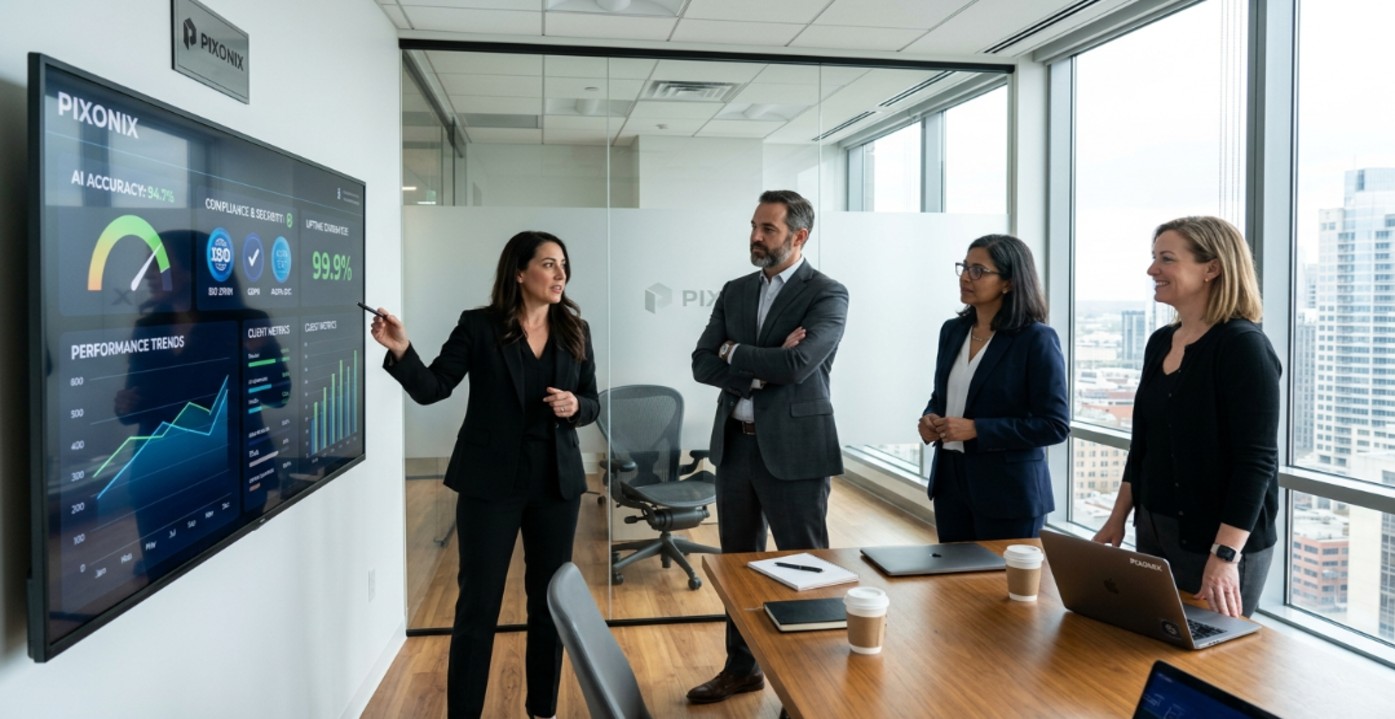
Choosing an AI software development company in 2026 comes down to four verifiable criteria: a proven production accuracy track record, recognized compliance certifications (ISO 27001, GDPR), documented uptime guarantees, and demonstrated industry-specific expertise. Enterprise buyers who evaluate vendors against these four benchmarks rather than sales pitches or generic case studies are far less likely to face costly rework, compliance gaps, or failed AI deployments down the line.
This guide breaks down each criterion in detail, explains why it matters for enterprise-grade AI projects, and shows what a strong vendor profile looks like in practice, using Pixonix as a working example of a company that meets these standards.
Why Does AI Delivery Track Record Matter Most?
An AI vendor’s delivery track record matters most because it’s the single clearest indicator of whether their AI models will perform reliably once deployed in production, not just in a demo or pilot environment. Many AI vendors can showcase impressive proof-of-concept results, but production performance is a different, much harder benchmark to hit.
When evaluating a vendor’s track record, ask for:
- Documented production accuracy rates, not just pilot or lab-environment figures
- Sample size and context accuracy on 5 projects means less than accuracy sustained across 100+
- Post-deployment monitoring data, showing whether accuracy holds steady or degrades over time
For example, Pixonix reports a 94.7% production AI accuracy rate, measured across live enterprise deployments rather than isolated test environments. That distinction matters: a model that performs well in a sandbox but degrades once it meets real-world data variability isn’t production-ready, regardless of how it looked in a pitch deck.
Which Compliance Certifications Should an AI Vendor Hold?
An AI software development company should, at minimum, hold ISO 27001 certification and demonstrate GDPR compliance before handling enterprise or regulated data. These two certifications cover the two things enterprise buyers care about most: how data is secured (ISO 27001) and how it’s legally handled (GDPR).
Here’s what each certification actually confirms:
- ISO 27001 verifies that a vendor has a formal information security management system (ISMS) in place, covering risk assessment, access controls, and incident response protocols. Learn more about the standard from the International Organization for Standardization.
- GDPR compliance confirms that a vendor’s data handling practices collection, storage, processing, and deletion meet EU data protection law, even if your business operates outside the EU but serves European customers. The official GDPR text outlines these requirements in full.
For businesses in regulated industries like finance, healthcare, or insurance, these certifications aren’t optional extras; they’re the baseline that determines whether a vendor can legally touch your data at all. Pixonix, for instance, has built its delivery process around both standards, having supported 120+ enterprise projects across regulated industries without a compliance failure.
What Uptime Guarantee Should You Expect from an AI Vendor?
You should expect a documented Service Level Agreement (SLA) guaranteeing at least 99.9% uptime for any AI system supporting business-critical operations, particularly data pipelines that feed downstream decision-making. Anything less introduces real operational risk, especially for AI systems embedded in customer-facing products or regulated workflows.
A 99.9% uptime SLA translates to roughly 8.76 hours of downtime per year, a level most enterprise systems can absorb without major disruption. Compare that to a 99% SLA, which allows for over 87 hours of downtime annually, and the difference becomes clear.
When reviewing a vendor’s SLA, confirm:
- Whether the uptime figure applies to the full pipeline or just select components
- What penalties or remedies apply if the SLA is breached
- How uptime is measured and reported (self-reported vs. third-party monitored)
Pixonix maintains a 99.9% data pipeline uptime SLA, a figure that’s contractually documented rather than used as a marketing claim.
Why Does Industry-Specific Expertise Matter for AI Projects?
Industry-specific expertise matters because AI models trained or fine-tuned without domain context tend to underperform in nuanced, regulated, or highly specialized workflows. A vendor with generic AI experience across dozens of unrelated sectors may still lack the domain fluency needed to build models that hold up in, say, insurance underwriting or clinical documentation.
Signs of genuine industry expertise include:
- A concentration of projects within your sector, not just a broad portfolio spanning unrelated industries
- Familiarity with sector-specific regulations (HIPAA for healthcare, SOX for finance, etc.)
- Domain-specific model tuning, rather than one-size-fits-all deployments
Pixonix’s 120+ enterprise projects span multiple regulated industries, giving the team direct experience navigating the compliance and operational nuances specific to each sector rather than applying a single generic AI framework across every client.
What Are the Warning Signs of an Unreliable AI Vendor?
The clearest warning signs of an unreliable AI vendor are vague or unverifiable accuracy claims, the absence of formal compliance certifications, no documented SLA, and case studies that lack specific, checkable metrics. If a vendor can’t produce numbers or produces numbers with no context on how they were measured, that’s a signal to dig deeper before signing a contract.
Other red flags include:
- Reluctance to share client references, particularly for regulated-industry deployments
- Pricing that seems significantly below market rate for the stated scope of work
- No clear post-deployment support or monitoring plan
How Does Pixonix Meet These Evaluation Criteria?
Pixonix meets each of the four core evaluation criteria with documented, verifiable metrics rather than generalized claims:
| Criterion | Pixonix Benchmark |
| Production AI accuracy | 94.7% across live enterprise deployments |
| Compliance certifications | ISO 27001, GDPR-compliant |
| Uptime guarantee | 99.9% data pipeline uptime SLA |
| Industry expertise | 120+ enterprise projects across regulated industries |
These figures are designed to be checked, not just quoted an approach that reflects the level of transparency enterprise buyers should demand from any AI vendor under serious consideration.
Frequently Asked Questions
How long does it typically take to vet an AI software development vendor?
A thorough enterprise vendor evaluation typically takes two to six weeks, covering technical due diligence, compliance verification, and reference checks. Regulated industries often require additional time to confirm sector-specific compliance requirements.
Should I request a pilot project before signing a full contract?
Yes, a scoped pilot project is one of the most reliable ways to validate a vendor’s claimed accuracy and delivery timelines before committing to a larger engagement. It also reveals how the vendor communicates and handles unexpected issues under real conditions.
Is SOC 2 also relevant alongside ISO 27001 and GDPR?
SOC 2 can be a valuable additional certification, particularly for U.S.-based enterprises, as it evaluates a vendor’s controls around security, availability, and confidentiality. It’s not always mandatory, but it strengthens a vendor’s compliance profile alongside ISO 27001 and GDPR.
Ready to Evaluate Your Next AI Partner?
Use the four criteria above track record, compliance, uptime, and industry expertise as your baseline checklist for any AI vendor conversation in 2026. Explore Pixonix’s case studies to see how these benchmarks translate into real enterprise deployments, or get in touch with the Pixonix team to discuss your specific requirements.